
You have probably heard of dogs being deployed to search for drugs or other illegal substances. But did you know that dogs can also help with wildlife conservation?
At IBREAM, we have been working with specially trained conservation detection dogs for a while now. And just like humans, they can work very hard. We want to shine a light on them and show how incredible they are in the work they do, and how they help towards the conservation of some amazing wild animals.
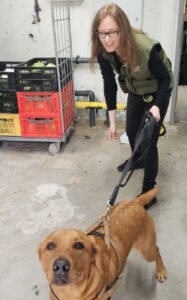
Our conservation detection dogs are trained under the supervision of and qualified by Mariska Snelleman, our very own conservation detection specialist. But what exactly is a conservation detection dog, and why do we need them?
Monitoring wildlife is not always straightforward. Many species are rare, elusive, nocturnal, or live in environments where visibility is extremely limited, such as dense rainforests. Traditional methods like camera traps, acoustic monitoring, or direct observations are very valuable, but they all rely on animals being in exactly the right place at the right time.
This is where conservation detection dogs make a difference!
Thanks to their extraordinary sense of smell and their strong partnership with humans, trained dogs can detect wildlife signs that we would easily miss. They can locate scat, identify specific animal scents, and even detect live animals in the field. In many cases, detection dogs are faster, more efficient, and more accurate than traditional monitoring methods. Another approach to obtain crucial information on elusive species, like the pygmy hippo and the African wild dog, is taking samples from the field into a central facility where they can be evaluated by dogs, rather than taking a trained dog-handler team to individual field sites. At IBREAM, our dogs help analyse fecal samples collected in the field. These samples are a rich, non-invasive source of information and can provide data on reproductive hormones, stress levels, immune function, genetics, and much more.
Each of our dogs has its own speciality, meet the IBREAM Conservation Detection Dog Team:
Senco
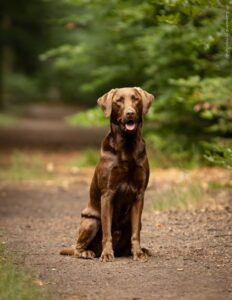
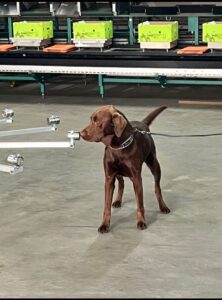
Senco is 3 years old and is a male field trial Labrador. And what do a Labrador and a pygmy hippo have in common? Well.. not very much. BUT! Senco loves pygmy hippo poop. Senco knows the smell of female pygmy hippo poop like the back of its hand (use something that’s more fitting for dogs here). By identifying female pygmy hippo poop Senco can help in identifying the distribution of female and male pygmy hippos in the wild.
Hummel
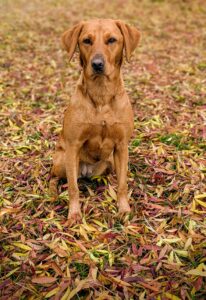

Meet Hummel (in English: Bumblebee)! Did you know Bumblebees symbolize the importance of hard work, diligence, and perseverance? These are exactly the characteristics of this 2 year old female field trial Labrador, who, you may have guessed it, also loves pygmy hippo poop! But unlike our other dog Senco (see previous post), Hummel loves the smell of male pygmy hippo poop. He is an expert determing the male pygmy hippo scent. Additionally, in the future Hummel will also help determine African wild dog poop, but then only from the alpha females.
Ruby

Last, but not least: Ruby! A beautiful female Labrador of 5 months old. She might be young, but she if full of passion and determination the help the conservation of the African wild dogs. She has just started to learning basic skills that are needed for this specialized detection work. The coming months she will undergo almost daily training to reach high accuracy levels to get Ruby to be at the top of her game!
We are incredibly proud of our conservation detection dogs and the important role they play in helping us protect wildlife.